Anyone who has booked a resort marked “accessible” online knows the disappointment that can follow. You arrive, and suddenly there are three steps to the restaurant, gravel between your room and the pool, and a bathroom with a tub where a roll-in shower should be. Resort accessibility is rarely what the booking checkbox promises, because labels are often based on a single detail, like a step-free entrance, while the rest of the property goes unchecked.
This guide walks you through what to actually verify before you pay. We look at why accessibility labels fall short, which room and bathroom details to confirm in writing, how to check pools, paths and shared facilities, and what to ask about transfers and terrain. You will also find advice on when to book and how to match the resort type to your mobility needs, so surprises after arrival become the exception rather than the rule.
Why Resort Accessibility Labels Are Not Enough
On most booking platforms, a resort can earn an “accessible” label from one feature alone: a step-free entrance at reception. That tells you nothing about the rooms, the pool, the restaurants or the route between them. A property can welcome wheelchair users through the front door and then present a dozen barriers the moment you move one step further in.
The language is part of the problem. Terms like “wheelchair friendly” have no standard definition anywhere in the travel industry. One resort may mean a fully adapted room with a roll-in shower; another may simply mean “we have no steps at the entrance.” Two properties with the identical label can differ completely, which is why the label itself is close to useless as a booking criterion.
What the photos leave out
Gallery images usually show the lobby, the pool at sunset and the best suite from its most flattering angle. They rarely show bathrooms, door thresholds or the path from your room to the pool, which is exactly where most problems appear in practice. A beautiful terrace photo will not tell you whether reaching it requires a flight of stairs.
The practical takeaway: treat any label or photo as a starting point, not an answer. Every detail that matters to you, from door widths to pool access, needs to be confirmed directly with the resort, ideally in writing. The sections below show you exactly what to ask.
Rooms and Bathrooms: The Details to Confirm in Writing
The room is where accessibility succeeds or fails, and vague questions get vague answers. Instead of asking “is the room accessible?”, ask for exact measurements and features, and ask the resort to confirm them in writing. Door widths are a good starting point: aim for at least 80-90 cm so a wheelchair passes comfortably, and check the bathroom door specifically, since it is often the narrowest in the room.
The bathroom deserves its own conversation. A tub with a step is not an acceptable substitute for many travelers, so confirm there is a roll-in shower rather than a tub. This is one of the three features most often missing despite an “accessible” label, along with pool lifts and grab bars, so never assume it exists.
Details worth putting on your checklist
- Grab bars and a shower seat: ask where the bars are mounted (toilet and shower) and whether the shower seat is fixed or fold-down, since portable seats are not always stable.
- Lowered wardrobe rails and reachable switches: confirm that hanging space, light switches and climate controls sit within reach from a seated position, not above head height.
- Bed height and clearance: ask whether the bed can be raised or lowered and whether there is space on at least one side for a side transfer.
- Emergency procedures: check whether there is an evacuation plan for guests who cannot use stairs, and whether staff are informed about your needs before arrival.
Finally, request a ground-floor room or one served by a lift in writing, not over the phone. Step-free rooms are typically only 2-5% of total room stock at most European resorts, so a verbal promise can easily dissolve into “that room type is sold out” by the time you arrive. A written confirmation with your booking reference attached is what holds.
Resort Grounds, Pools and Shared Facilities
An accessible room is only useful if you can actually reach the restaurant, the pool and the beach from it. Before booking, ask how the paths between reception, rooms, restaurants and the beach or slopes are surfaced. Paved, firm paths are workable; gravel, soft sand or cobbles are not. Also ask about gradients, since a paved route still matters little if it climbs a steep hill between your room and dinner.
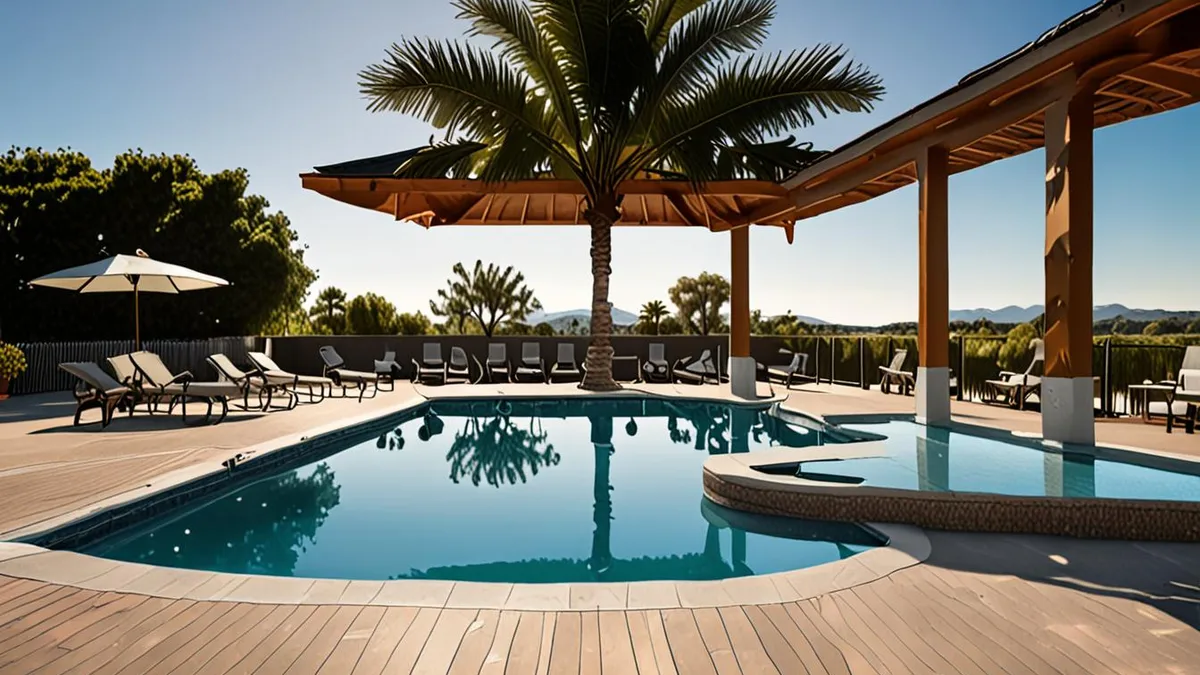
The pool is the classic weak point. Ask specifically whether there is a pool lift or a zero-entry pool, because pool lifts, roll-in showers and grab bars are the three features most likely to be absent even when a resort advertises itself as accessible. A resort can have a ramp to the sun deck and still offer no way into the water itself. This applies to coastal properties too: if you are browsing Baltic Sea coastal resorts for a beach holiday, ask how the beach and promenade are reached from the grounds, since dunes and boardwalks vary widely between properties.
Shared facilities to verify one by one
- Lift access to restaurants, spas and terraces: many resorts spread facilities across levels, so confirm each one individually rather than asking about “the resort” in general.
- Accessible toilets in public areas: ask where they are located near the pool, beach and dining areas, not just inside guest rooms, since a trip back to your room mid-meal is a real disruption.
- Pool surrounds and sun loungers: check whether there is firm, non-slip surfacing around the pool and whether staff can help adjust loungers or provide a transfer-friendly option.
- Beach access points: ask whether there is a boardwalk or ramp onto the sand and whether beach wheelchairs are available to borrow.
Get these answers in writing alongside your room confirmation. Grounds and facilities are the areas where “accessible” labels drift furthest from reality, and a resort that answers these questions precisely is usually one that has genuinely thought about access.
Getting There: Transfers, Terrain and Distance
One of the most overlooked parts of an accessible resort stay is simply getting there. Many resorts run their own shuttle service from the airport or train station, but these standard shuttles often have no ramp or lift. If you use a wheelchair, the shuttle may be completely unusable even though the resort itself is well equipped. Arrange an accessible transfer at least 2 weeks before arrival, and confirm in writing that the vehicle has a ramp and securement points.
Once you arrive, the layout of the resort matters just as much as the room. Hillside and lakeside resorts frequently have stairs between levels, with reception at the top, the restaurant in the middle and the pool or beach below. A property can call itself accessible because one room is step-free, while every route out of it involves steps. Ask for a map of step-free routes before booking, and check whether there are ramps or lifts connecting the different levels.
How far is too far?
Finally, check the distance from the nearest station or airport. A 30-60 minute transfer on winding mountain roads can be uncomfortable or impractical if you cannot use a standard taxi or need regular stops. A resort that looks close on the map may be an hour away on narrow, switchback roads, so factor the journey itself into your decision and ask the resort what transfer options they can realistically arrange for you.
Questions to Ask and When to Book
Getting reliable accessibility information takes a little planning, but the effort pays off many times over. The key is to move from vague labels to written commitments from the resort itself, and to time your requests so that the few accessible rooms are still available. Because step-free rooms make up such a small share of room stock at most European resorts, the resorts themselves are usually quick to respond when a guest asks detailed questions. A reservation team that answers clearly and specifically is also a good sign of how seriously the property takes accessibility overall.
- Email the resort directly 4-8 weeks before booking. Skip the booking site’s checkbox and ask the resort for specifics in writing: door widths, roll-in shower, pool lift, step-free routes. A written reply is something you can hold them to, unlike a marketing label, and it gives you a record if anything changes later.
- Book as early as possible for a July-August stay. Accessible rooms often cost the same or 0-10% more than standard rooms, but they sell out first in peak summer. If you find a suitable room at a small premium, take it rather than waiting and hoping something better appears.
- Reconfirm every arrangement 1-2 weeks before arrival. Go back over the room type, the accessible transfer and any equipment rental you arranged. Staff change, notes get lost, and a short reconfirmation email catches problems while there is still time to fix them.
Treat these steps as a routine you run for every trip, not a one-off chore. The first contact builds your paper trail, the early booking secures the room before peak demand takes it, and the final reconfirmation makes sure everything you were promised actually happens on the day you arrive. Once you have done it a couple of times, the whole process takes little more than an hour of emails spread across a few weeks, and it removes most of the uncertainty from booking an accessible stay.
Choosing the Right Resort Type for Your Needs
Not every resort has the same chance of working for you, and knowing which types to shortlist first can save you a lot of back-and-forth emails. A building’s age, its setting and the guests it is designed for all shape how accessible it realistically is, long before you get to the fine print.
Modern versus historic properties
Large modern resorts more often have lifts, pool lifts and step-free layouts built in from the start, because current construction standards require them. Small historic properties and cliffside hotels, charming as they are, frequently have stairs at the entrance, split-level terraces and narrow doorways that no amount of goodwill can fix. If step-free access is essential, favor newer, larger complexes and treat character properties as the exception that needs extra verification before you commit.
Terrain and guest type
Flat lakeside and coastal resorts are usually easier to move around than mountain or ski resorts, where the terrain itself is the main barrier. Even a fully renovated mountain property can sit on a slope that makes every trip to breakfast a challenge. Think honestly about how much ground you will cover each day before choosing a dramatic hillside setting for the view.
Guest type matters too. Family-oriented resorts more commonly offer accessible rooms, shower chairs and other equipment, because they serve a wider range of guests. Check those first, and only then look at quiet boutique retreats, which may have just a handful of rooms and no adapted ones at all. Choosing a resort style that fits how you actually travel is the simplest way to avoid most surprises later.
Wrapping Up Your Accessibility Check
The gap between a glossy booking page and reality is exactly what this guide is designed to close. Because accessibility labels alone are unreliable, the written confirmation of your room, paths and pool access is what truly protects your booking. Getting those details in email, not just a checkbox on a booking site, gives you something to fall back on if anything goes wrong at check-in.
Timing covers the other two points of failure. Booking 4-8 weeks ahead and reconfirming 1-2 weeks before arrival means your ground-floor room, transfer and equipment are settled at both moments when plans most often slip. And by matching the resort type to your mobility needs, from flat lakeside stays to lift-served modern complexes, you prevent most surprises before they ever happen. If this guide helped you plan a trip, leave a comment or share it with a fellow traveler.